
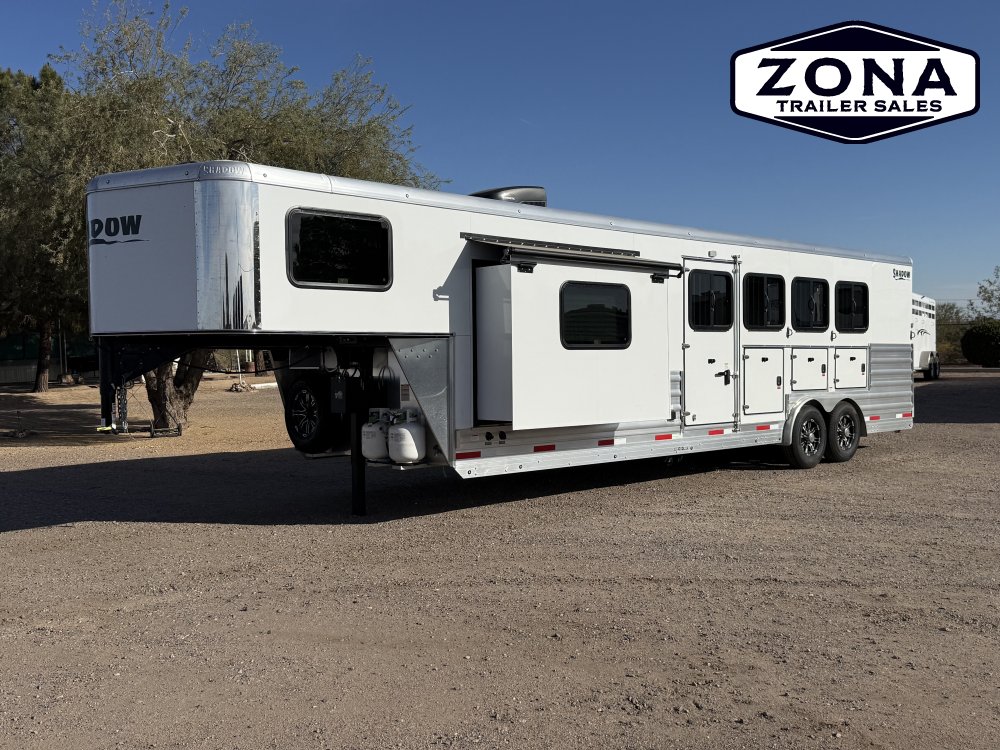
How much does a horse trailer weigh? A small 2-horse bumper pull and a large gooseneck horse trailer with living quarters can be thousands of pounds apart, so there is no single number that applies to every horse trailer.
More importantly, the empty weight is only the beginning. Horses, tack, feed, water, equipment, and other cargo all increase the weight your truck actually has to handle. That's why buyers should understand empty weight, GVWR, GAWR, payload, and hitch weight before choosing a trailer or tow vehicle.
Browse Zona Trailer Sales' current horse trailer inventory and compare actual trailer weights, GVWR ratings, sizes, horse capacities, and configurations.
Shop Horse TrailersHow Much Does a Horse Trailer Weigh?
Horse trailer weight varies considerably based on trailer size, construction material, horse capacity, bumper pull vs. gooseneck design, tack space, living quarters, axles, and installed equipment.
As a general reference, the categories below show why asking for the weight of a "horse trailer" without knowing the configuration can be misleading.
| Trailer Type | Typical Weight Pattern | Why Weight Changes |
|---|---|---|
| 2-Horse Bumper Pull | Usually among the lighter full-size horse trailer configurations | Steel vs. aluminum, tack room, trailer dimensions, axles and options |
| 3-Horse Bumper Pull | Typically heavier than a comparable 2-horse trailer | Additional length, horse capacity, tack space and equipment |
| 3-4 Horse Gooseneck | Often substantially heavier than a basic bumper pull | Larger frame, gooseneck structure, more stalls, tack and storage |
| Stock / Combo Horse Trailer | Varies widely | Length, material, gates, tack room, axle configuration and GVWR |
| Living Quarters Horse Trailer | Among the heaviest common horse trailer configurations | Living quarters, tanks, appliances, batteries, propane, furnishings, additional length and horses |
These categories are useful for comparison, but you should never select a tow vehicle based on an internet "average horse trailer weight." Use the weight and ratings of the exact trailer you're considering.
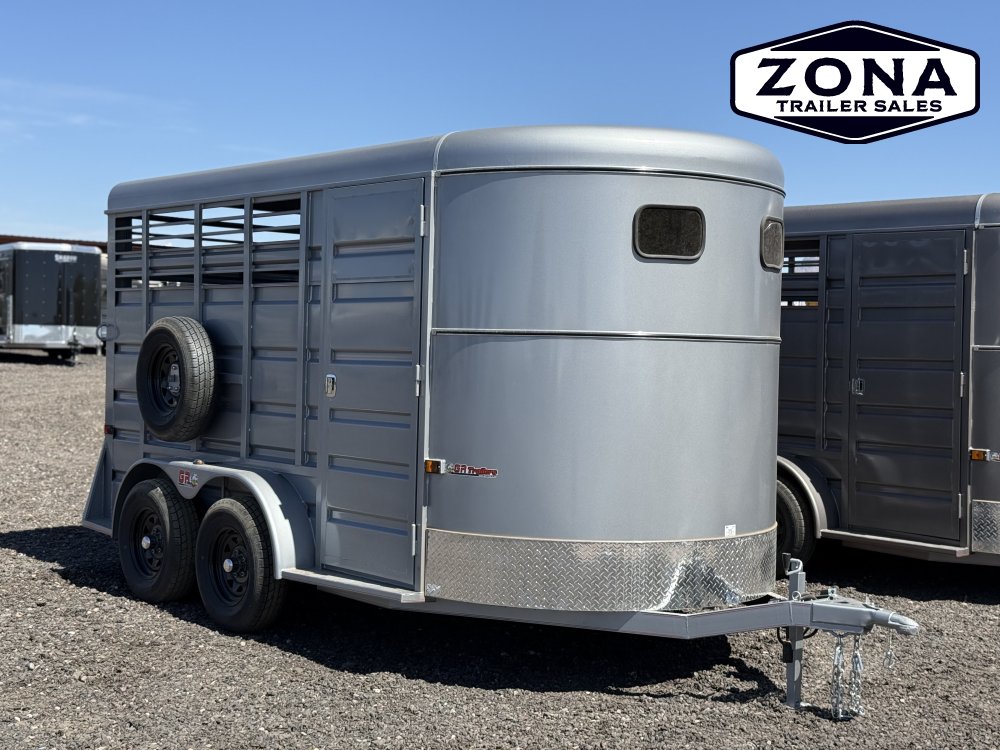
Real Example: How Much Does a 2-Horse Trailer Weigh?
A real trailer is more useful than a generic average.
The GR 2 Horse Slant shown above is an example of the type of compact bumper pull horse trailer buyers may encounter when shopping at Zona.
But even two trailers that both carry two horses can have different empty weights. One may be steel, another aluminum. One may have a larger front tack area, additional height, heavier axles, more equipment, or different structural construction.
That's why the specification plate and actual manufacturer information should always take priority over a generic online estimate.
Empty Weight vs. Loaded Weight
This distinction is critical.
Empty weight generally refers to what the trailer weighs before you add horses, tack, feed, water, equipment, and other cargo.
Loaded trailer weight is what the trailer actually weighs when prepared for the road.
Empty Trailer Weight
+ Horses
+ Tack
+ Feed & Hay
+ Water
+ Equipment & Supplies
= Estimated Loaded Trailer Weight
For example, two horses alone can add roughly a ton or more depending on their individual weights. Saddles, tack, hay, water, tools, and equipment add even more.
Living quarters add another layer because fresh water, waste tanks, propane, batteries, food, clothing, and personal gear can significantly increase travel weight.
What Does GVWR Mean on a Horse Trailer?
GVWR stands for Gross Vehicle Weight Rating.
It is the manufacturer's maximum rated weight for the trailer and its load. That includes the trailer itself plus horses, tack, water, feed, equipment, and other cargo.
GVWR is a rating, not the trailer's empty weight.
A trailer with a 7,000-pound GVWR does not necessarily weigh 7,000 pounds empty. The difference between the trailer's empty weight and its allowable loaded weight is part of determining how much payload is available.
What Does GAWR Mean?
GAWR stands for Gross Axle Weight Rating.
It represents the maximum rated load for an axle or axle system as specified by the manufacturer.
Do not assume that adding the axle ratings together automatically tells you everything you need to know about trailer capacity. GVWR is determined for the complete trailer, and components such as the frame, tires, wheels, coupler, suspension, and axles all have ratings and limitations.
Use the manufacturer's stated GVWR rather than creating your own rating from individual component numbers.
What Is Horse Trailer Payload?
Payload is the amount of weight available for what you put into or onto the trailer.
A basic estimate is:
Always verify the manufacturer's specifications because published empty weights, optional equipment and actual finished trailer weights can differ.
Payload has to cover more than the horses.
Saddles, tack, hay, feed, water, tools, portable panels, equipment, and anything else carried in the trailer all count toward the total load.
How Much Does a 2-Horse Trailer Weigh Loaded?
Start with the actual empty weight of the trailer, then add the real weight of everything you're carrying.
Here's a hypothetical example:
| Item | Example Weight |
|---|---|
| Empty horse trailer | 3,400 lbs |
| Horse #1 | 1,100 lbs |
| Horse #2 | 1,100 lbs |
| Tack, feed and equipment | 400 lbs |
| Estimated Loaded Weight | 6,000 lbs |
This example is for illustration only. Your horses and equipment may weigh considerably more or less, and the actual empty weight of the trailer must be verified.
What Is Tongue Weight?
On a bumper pull trailer, tongue weight is the portion of the trailer's weight pressing downward on the hitch.
This matters because the truck must handle more than the trailer's total weight. The hitch, receiver, truck payload capacity, rear axle rating, tires, and suspension all have limitations.
Adding passengers, tools, coolers, feed, tack, or other cargo to the truck also uses part of the truck's available payload.
A truck can therefore appear to have enough advertised towing capacity while running out of payload capacity first.
What About Gooseneck Horse Trailer Weight?
Gooseneck trailers transfer a significant portion of their load into the truck bed rather than onto a receiver behind the bumper.
This is one reason truck payload, rear axle capacity, tires, and the actual gooseneck hitch rating become especially important.
Larger gooseneck horse trailers can also weigh considerably more than basic bumper pulls because they may carry three, four, five, or more horses along with tack rooms, storage, additional axles, and larger structures.
Living Quarters Horse Trailers Change the Equation
Living quarters can increase trailer weight substantially.
In addition to the horse compartment, an LQ trailer may contain cabinetry, furniture, appliances, batteries, propane tanks, plumbing, fresh and waste water tanks, air conditioning, generators, slide-outs, and other equipment.
As one real-world example, Zona currently lists a 2026 Shadow 14'6" LQ 3 Horse at approximately 9,500 pounds empty with a 15,000-pound GVWR.
That illustrates why towing requirements for a large LQ trailer are fundamentally different from those for a small 2-horse bumper pull.
Browse Living Quarters Horse Trailers
Can a Half-Ton Truck Pull a Horse Trailer?
Sometimes, but you cannot answer this safely from the words "half-ton" alone.
Modern half-ton pickups can have dramatically different towing and payload ratings depending on engine, cab, bed length, drivetrain, axle ratio, towing package, wheels, tires, and other equipment.
A properly equipped half-ton may be capable of towing certain smaller horse trailers while remaining within all manufacturer ratings.
Another half-ton of the same model may have significantly less capacity.
Check the specific truck's certification labels, owner's manual, hitch rating, payload information, and manufacturer towing documentation rather than relying on the badge on the side of the truck.
When Do You Need a Three-Quarter-Ton Truck?
As trailer weight, horse count, tongue or pin weight, and cargo increase, buyers often move into three-quarter-ton trucks because these trucks are generally configured with greater payload, axle, suspension, and towing capability than lighter-duty pickups.
That does not mean every 3/4-ton can automatically pull every horse trailer.
A large gooseneck or living quarters trailer can still exceed the ratings of certain three-quarter-ton configurations, particularly once the truck and trailer are fully loaded.
When Do You Need a One-Ton Truck?
One-ton trucks become increasingly relevant with larger gooseneck and living quarters trailers, especially when pin weight and truck payload are major considerations.
Single-rear-wheel and dual-rear-wheel one-ton trucks also have different ratings and capabilities.
Again, the badge is not the answer. The exact truck configuration and its ratings determine what it can handle.
| Truck Class | Horse Trailer Use | Main Limitation to Watch |
|---|---|---|
| Half-Ton | May work with certain smaller/lighter horse trailers when properly equipped | Payload, hitch capacity, rear axle rating and loaded trailer weight |
| Three-Quarter-Ton | Common consideration as trailer size, load and gooseneck use increase | Payload and pin weight can still become limiting factors |
| One-Ton SRW | Often considered for larger goosenecks and LQ trailers | Verify payload, rear axle, tires, hitch and actual loaded combination |
| One-Ton DRW | Common with heavier gooseneck and living quarters applications | Still must remain within every applicable truck and trailer rating |
How to Match a Horse Trailer to Your Truck
Before buying the trailer, collect the ratings for the exact truck you intend to use.
- Truck GVWR
- Truck GAWR, especially rear axle rating
- Payload capacity
- Manufacturer towing capacity
- GCWR where applicable
- Receiver or gooseneck hitch rating
- Tire ratings
- Trailer GVWR
- Actual loaded trailer weight
- Expected tongue or pin weight
Use the lowest applicable rating as a limit. Upgrading one component does not automatically increase ratings assigned by the truck or trailer manufacturer.
Before towing, review your truck and trailer manufacturer's ratings and make sure your loaded combination stays within those limits. For additional guidance on towing terminology, weight ratings and safe trailer operation, review NHTSA's trailer towing safety guidance .
The Best Way to Know Your Actual Weight: Use a Scale
Calculations are useful when planning a purchase, but weighing the loaded truck and trailer provides much better information once you have the combination.
A certified vehicle scale can help you determine actual truck, trailer, axle, and combination weights depending on how the weighing is performed.
This is particularly useful for living quarters trailers, goosenecks, commercial hauling, or any setup operating close to its rated capacities.
Don't Forget the Truck's Payload
This is one of the easiest numbers to overlook.
Payload isn't just cargo sitting in the truck bed. Passengers, tools, hitch equipment, coolers, feed, tack, and the downward force imposed by the trailer can all affect how much capacity remains.
That's why looking only at a truck advertisement that says it can "tow" a certain number of pounds can give you an incomplete picture.
Find a Horse Trailer That Fits Your Tow Vehicle
Tell Zona what truck you have, what horses you haul, and what you need from the trailer. We can help you compare trailer sizes, configurations, empty weights, GVWR ratings, and available inventory.
Shop Horse Trailers Explore FinancingHorse Trailer Weight FAQs
How much does a 2-horse trailer weigh?
It depends on construction, dimensions, material, tack space, axles, and equipment. Two 2-horse trailers can have significantly different empty weights, so use the specifications for the exact trailer rather than relying on an average.
How much does a 2-horse trailer weigh loaded?
Add the trailer's actual empty weight to the weight of both horses plus tack, feed, water, and equipment. A trailer weighing roughly 3,400 pounds empty with two 1,100-pound horses and 400 pounds of equipment would weigh about 6,000 pounds loaded. This is only an example, not a universal 2-horse trailer weight.
How much does a horse and trailer weigh together?
Add the actual trailer weight to the horse's weight and everything else carried in the trailer. For multiple horses, include each horse separately. The safest way to determine actual loaded weight is to weigh the combination on an appropriate vehicle scale.
What is the average horse trailer weight?
An average is not particularly useful because horse trailers range from compact 2-horse bumper pulls to large multi-horse goosenecks and living quarters trailers. Use trailer type as a starting point, then verify the manufacturer's weight for the specific model.
Does GVWR mean how much the trailer weighs?
No. GVWR is the maximum rated weight of the trailer and its load. It is not the same as empty trailer weight.
Does horse trailer weight include the horses?
Published empty trailer weight generally does not include horses or cargo. Horses, tack, feed, water, and equipment must be added when estimating loaded trailer weight.
Can a half-ton truck pull a 2-horse trailer?
Some properly equipped half-ton trucks can tow certain 2-horse trailers while remaining within all applicable ratings. Others cannot. Check the exact truck's payload, GVWR, GAWR, towing capacity, hitch rating, tires, and the trailer's actual loaded weight.
Do I need a 3/4-ton truck for a horse trailer?
Not for every horse trailer. Smaller trailers may fall within the ratings of certain properly equipped lighter-duty trucks. As trailer size, payload, horse count, and hitch or pin weight increase, moving to a higher-capacity truck may become necessary.
What truck do I need for a living quarters horse trailer?
It depends on the actual loaded trailer, pin weight, truck payload, GVWR, GAWR, GCWR, hitch rating, and manufacturer towing specifications. Many larger living quarters trailers require substantially more truck than a basic bumper pull horse trailer.
Browse Zona's current horse trailers and compare the actual configuration, weight, GVWR, horse capacity, and features of the trailers you're considering.
View Horse Trailers for SaleTrailer weights and vehicle ratings vary by model, configuration, optional equipment, cargo, and actual finished weight. This guide is general information and is not a substitute for the towing requirements provided by the truck, trailer, hitch, tire, or component manufacturers. Verify all applicable ratings before purchasing, loading, or towing a trailer.